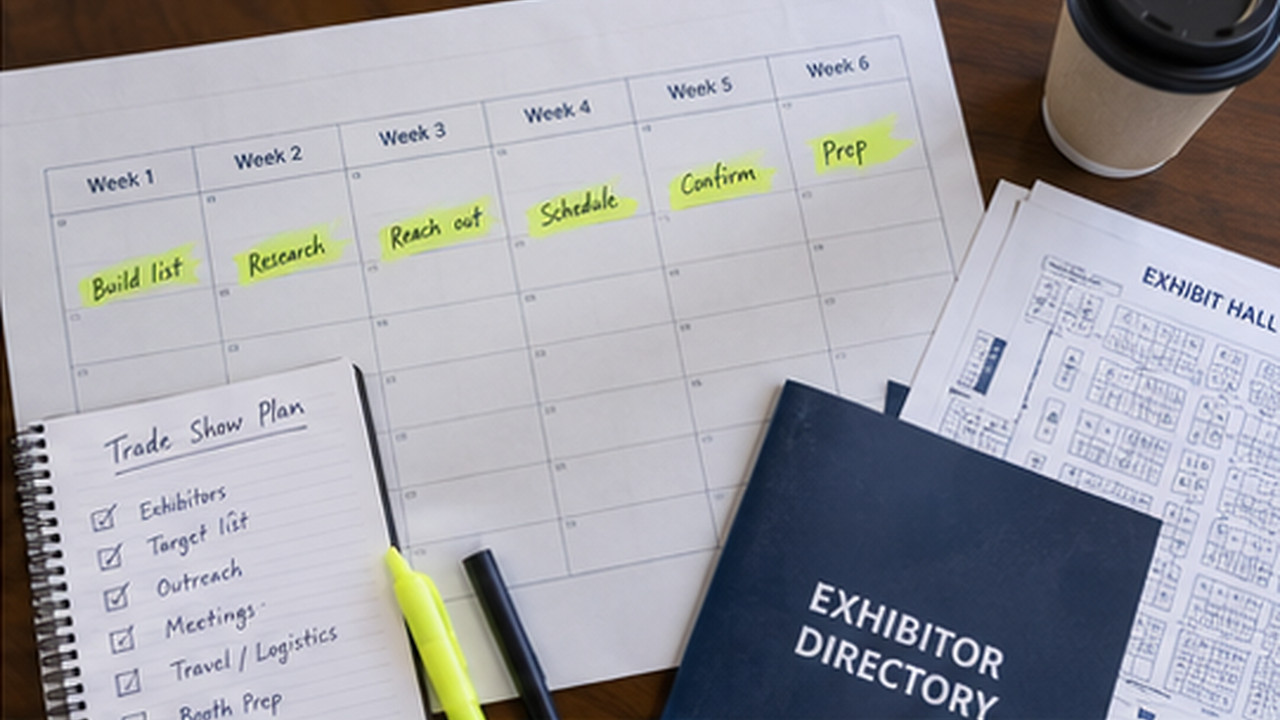


Trade shows publish a list of the companies that paid for booths. It is long, unevenly labeled, and easy to ignore once the hall opens. That list is where Exhibit Meetings starts. It is not what we sell you.
The distinction matters, because a lot of show services are really about the other population in the building: attendees, the people who bought a ticket to walk the aisles. We do not sell those names, and we do not sell the exhibitor list either. We use the list as the map of companies that will already be there, and we turn it into confirmed conversations with the ones that matter to you.
Two populations, one building
An exhibitor rented a piece of floor. They have a booth number, a reason for spending the money, and a staff that will be standing in that square for several days. A distributor you have wanted for a year may be two halls away, doing the same thing you are doing: talking to whoever happens to stop.
An attendee bought a pass. Some of them are buyers. Many of them are not the person who can start a distribution or supply relationship. Collecting badge scans is a different product, sold by different firms, with a different kind of consent and a different kind of disappointment. When we say we do not sell attendee data, we mean that product is not ours.
The companies you are most likely to need a planned meeting with are often exhibitors themselves. They will not wander into your booth on a schedule. The hall is too big, and their staff is as stuck as yours.
Why the official list, and not a scrape
We do not begin by searching the open web for firms that sound adjacent to you. The advantage of a show is that both companies have already committed to the same building, the same week, in a commercial frame of mind. The exhibitor list is the document that records that commitment.
You do not have to build the list. You do not have to clean it. You also do not receive it as a spreadsheet at the end. The list is an input to research. The output, when a conversation is worth proposing, is a short written reason and then an email to both sides.
If a company is not exhibiting, it is outside this service even if it would be a good call in March. We would rather keep the boundary bright than quietly turn the work into general lead generation.
A reason, or the name comes off
Every company that stays on the working list gets a paragraph that would make sense to your team. The paragraph says who they are, why they fit the goal you named, who we would ask for, and what the first question is. “They are also at the show” does not survive that test. Neither does a category match so broad that it would describe a quarter of the hall.
This is the filter that keeps the work from becoming a blast. If the paragraph cannot be written, we do not email them. You can read the names before anything goes out, and you can veto a name for any reason. Competitors, current customers, and anyone else you put out of bounds are excluded before that stage.
An example card looks like this. Corbel Dough Systems, booth N-118, is on the list of a food show where an oven exhibitor wants equipment partners and not other oven brands. The reason is that their buyers already shop for the thing the oven company sells beside. The person to ask for is a product or sales lead. The first question is whether they specify that equipment in house. If we cannot get to something that specific, Corbel Dough Systems is a line we skip.
Both sides, and then we stop
The email is short. It names the show, the two companies, and the reason. It is one introduction, not a send to the floor.
Both sides have to say yes before we put a time on a calendar. One no, and we stop. No reply, and we send a single reminder, then we stop. We do not treat silence as interest, and we do not keep a sequence running because a sequence is what some tools do by default.
If someone we contacted asks to be taken off the list, they come off. That is not a special case. It is the same rule as your exclusion list: people who should not be in the conversation are not in it.
What you are actually buying
You are not buying the list, attendee names, or a file of addresses. You are buying the work of turning that list into meetings.
You are buying research and outreach for one show, bounded by dates, by who on your team can actually take a meeting, and by a spending ceiling agreed before we start. The $1,000 base fee pays for that work even when no meeting is booked. A $300 fee is added only when a booking is qualified: right show, right fit, relevant person, written reason, and both sides agreed in writing to a time and a place.
Why this is slower than buying a file
Reading a list of a thousand exhibitors, throwing out the ones that do not fit, and writing a real reason for the ones that do is not a same-day export. That is the work. A file would be faster to deliver and worse to use. Your team would still have to do the reading, during a week when they are also standing on a booth.
The meetings that do get booked can be on video before the show or at the booth during it. Either way, the brief is one page: who they are, who is in the room, why the match was made, and one question to open with. After the show, a short recap covers what was reported and what is worth following up. We do not bill you for the recap, and we do not bill you to prove that someone attended.
If the list is the wrong tool
Some goals are not exhibitor goals. Filling the booth with walk-up traffic, renting a larger stand, or buying a regional email list are real projects, and they are not this one. If what you need is a planned conversation with a certain kind of company that has already paid to exhibit, the list is the right place to start, and the list itself stays with the research.
When you are ready, send the show, the dates, a sentence on what a good meeting is, and the names we should not contact. alex@exhibitormeetings.com, or book a 15-minute call. We reply within one business day. If we cannot see a clear target, we will say that before we take the base fee.